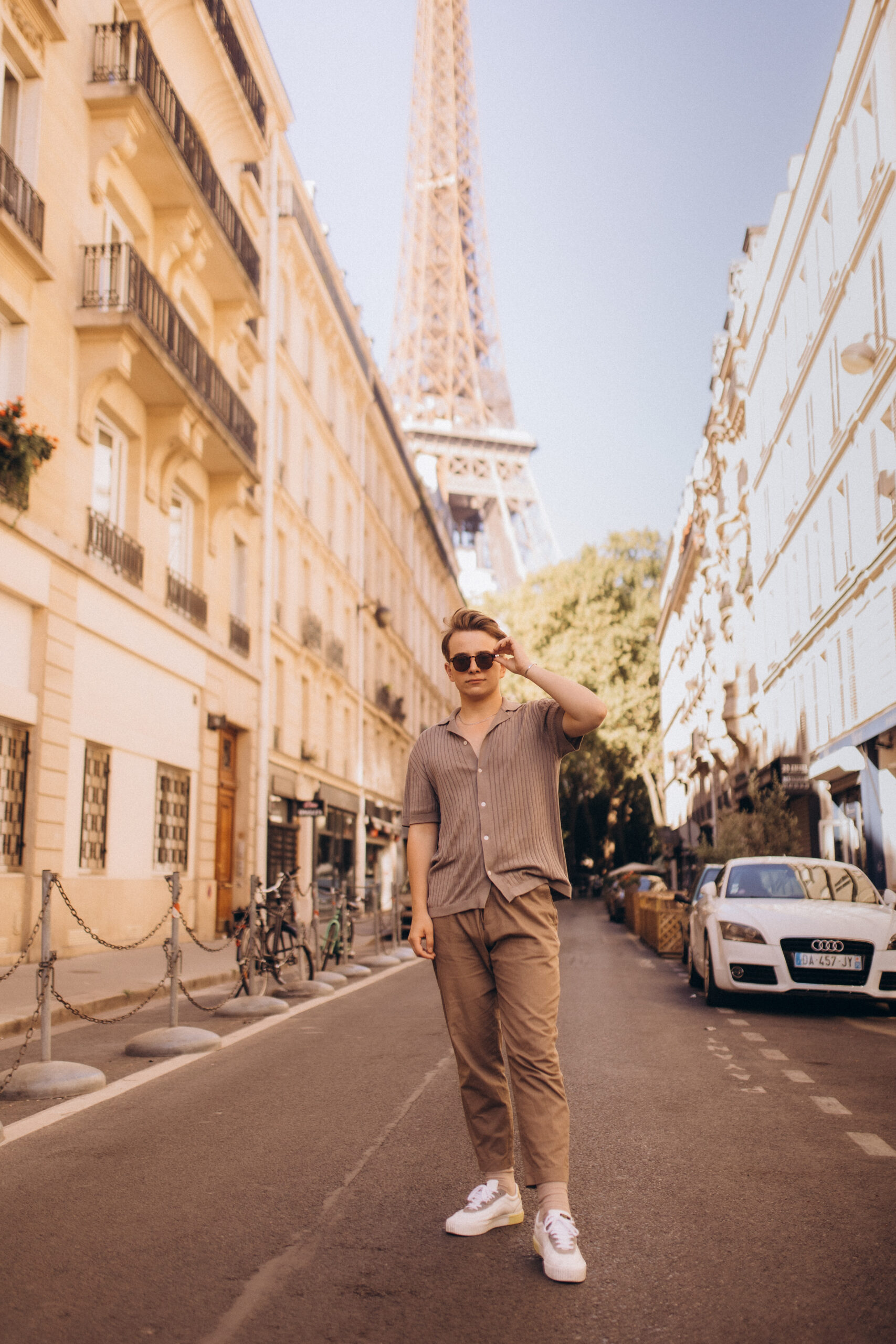
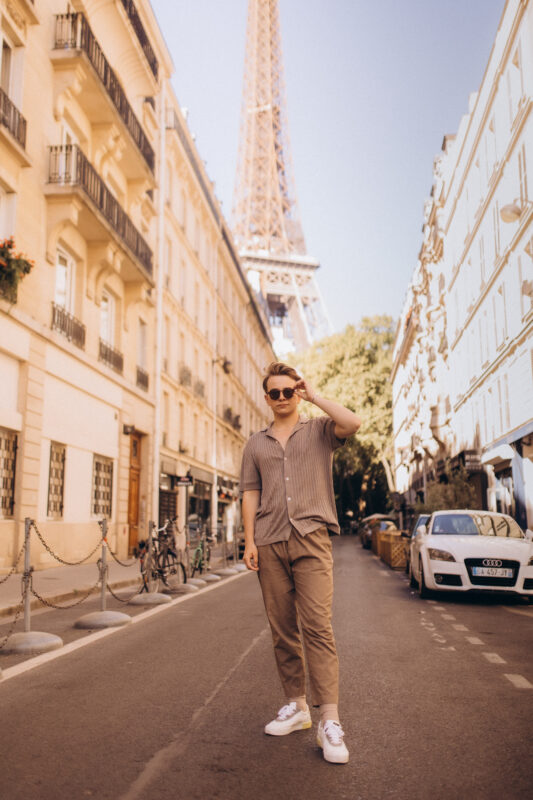
The first frame feels calm, but the city is moving inside it. A young man stands in a narrow Paris street, dressed in warm neutral tones, while a famous iron landmark rises between pale residential buildings behind him. Bicycles wait beside the sidewalk, cars line the curb, and soft sunlight brushes the facades with gold. He looks away from my camera as if something beyond the frame has caught his attention. That balance between intention and chance is what I love most about Paris street photography.
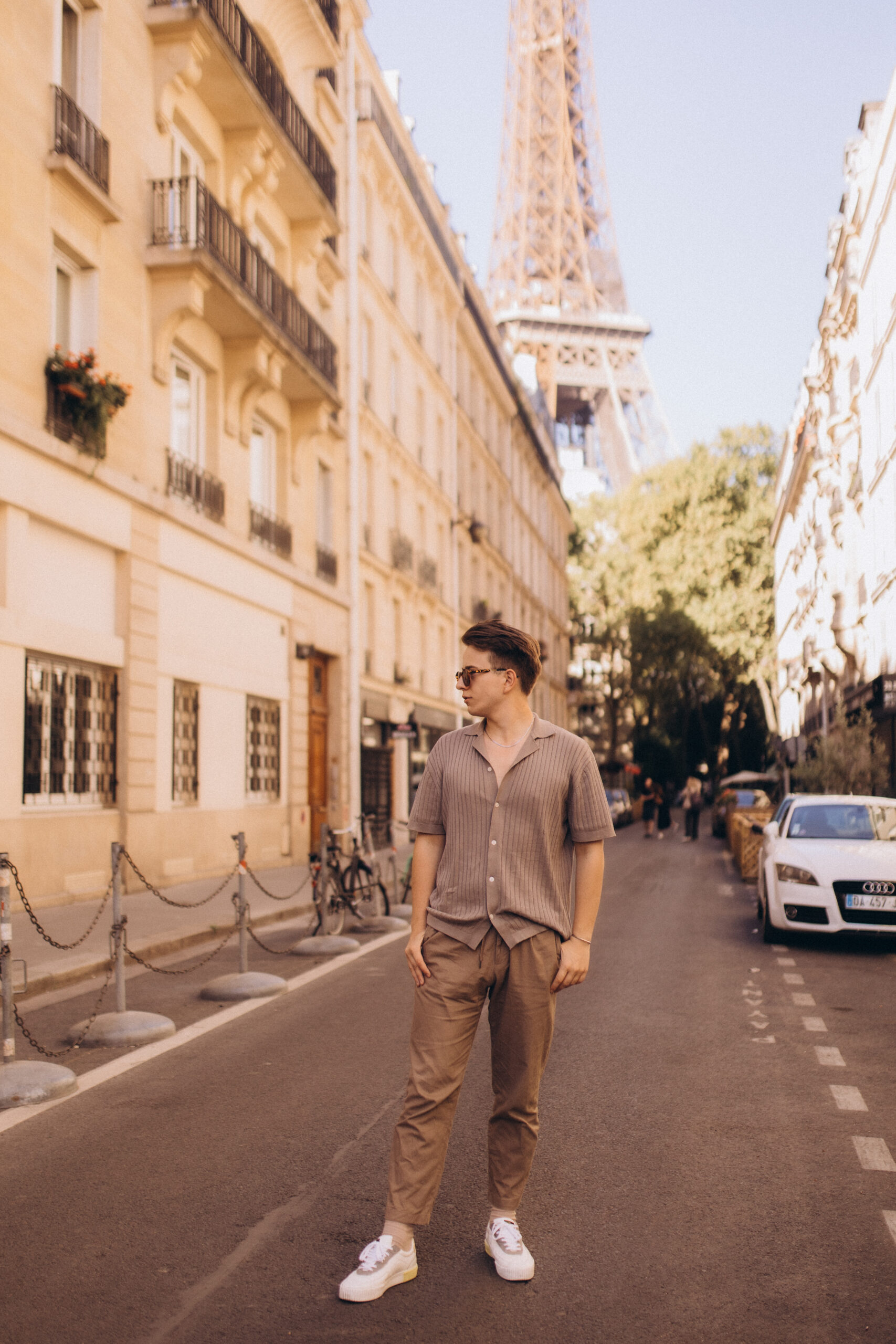
A Paris street photography portrait by Julia Litvin at litvinphoto.com, a young man standing on a quiet Haussmann street as a famous iron landmark rises softly at the end.
This was not a documentary session built around photographing unsuspecting strangers. It was a guided solo portrait walk shaped by the visual language of the street. I chose the perspective and offered direction, but I left room for real gestures and unexpected encounters. The result sits naturally between travel portraiture, editorial work, and street photography in France.
When a Portrait Feels Like Paris Street Photography
For me, a street portrait succeeds when the setting does more than identify the city. It should add rhythm, scale, texture, and mood. In the opening photograph, the long facades create leading lines toward the distant iron structure, while the subject interrupts that geometry with a relaxed human presence. I did not want the landmark to become the entire story. Paris street photography feels more personal when a recognizable view remains part of everyday surroundings instead of turning into a decorative backdrop.
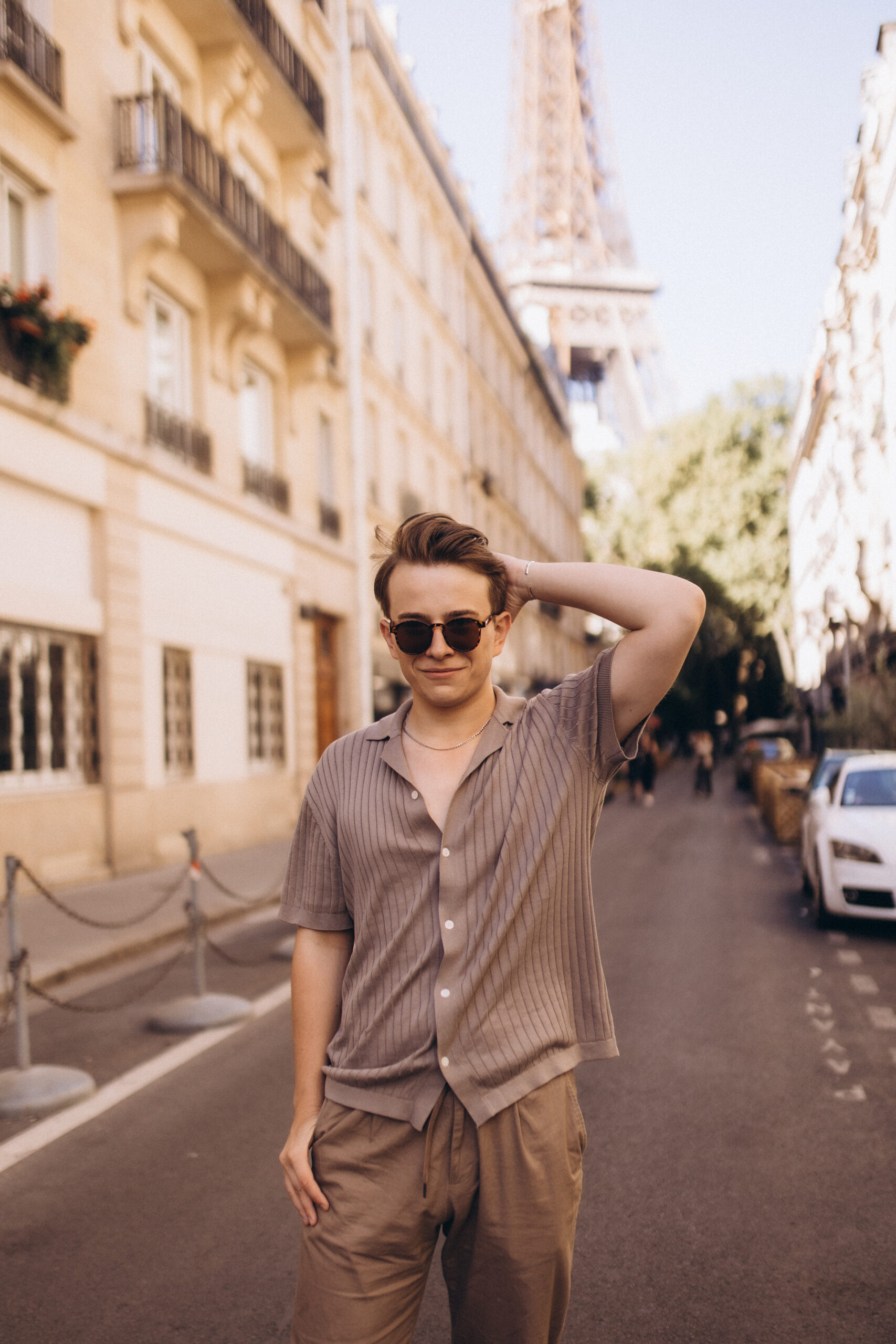
The second photograph uses the same street but changes the energy. He faces my camera and lifts one hand toward his sunglasses. It is a small gesture, yet it adds confidence and movement. His open knit shirt, tapered trousers, white sneakers, and understated jewelry create a contemporary silhouette without appearing overly styled. Because the palette stays close to the warm stone around him, his posture and expression become more important than color.
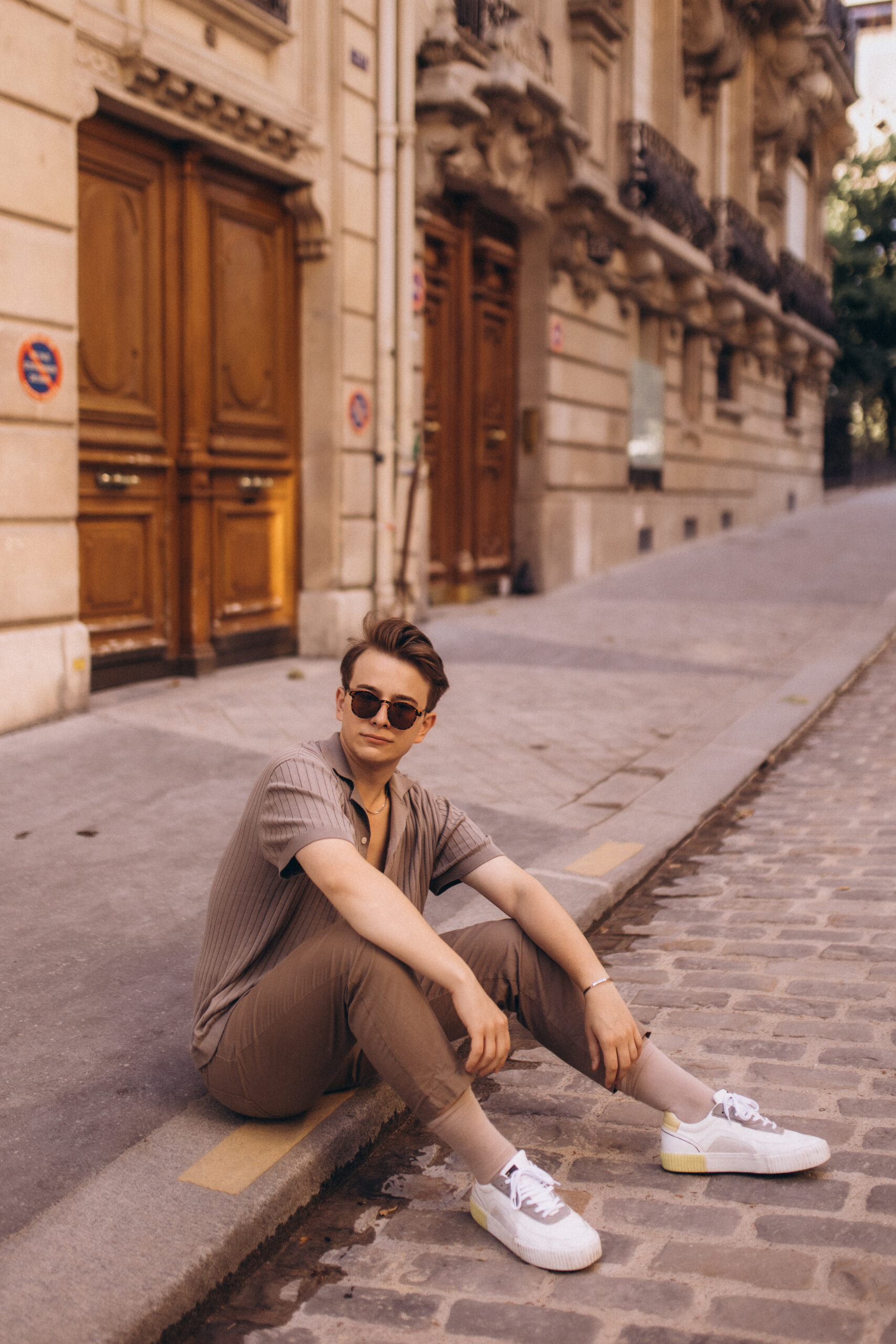
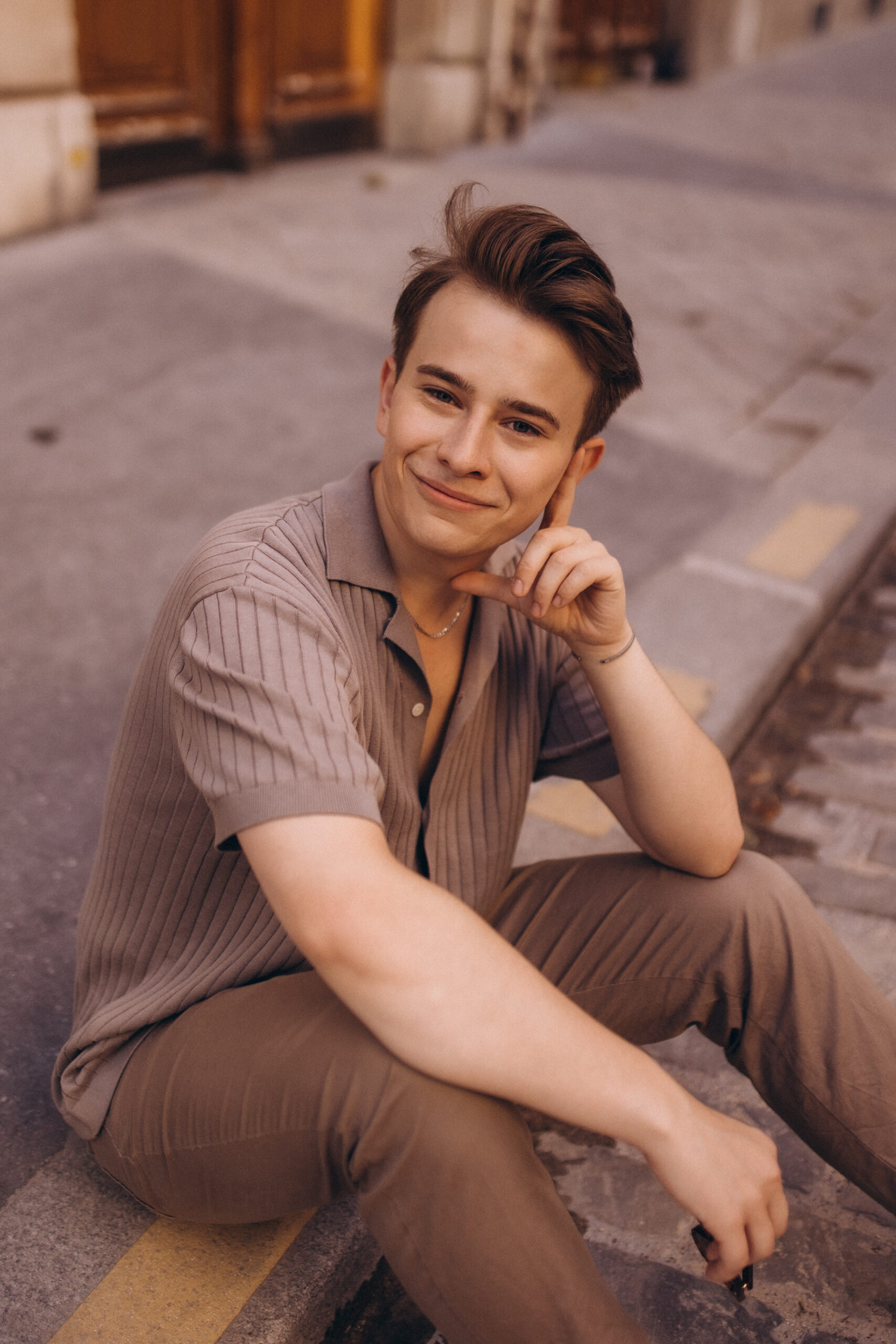
I often begin with wider compositions because they give someone time to settle into the session. Walking, looking across the street, or adjusting sunglasses feels easier than immediately holding a close pose. Once that first tension disappears, I move nearer. In the third image, he sits at the edge of the street with his sunglasses in one hand and his face resting lightly against the other. The city softens behind him, and the photograph becomes about openness rather than location.
This progression is central to my approach to Paris street photography. I move gradually from full-length frames to intimate portraits as the person becomes comfortable. Since I started photographing in Paris in 2018, I have learned that trust changes a face more beautifully than complicated posing.
Turning an Ordinary Street Into a Composition
Paris offers grand architecture, but its ordinary visual details are just as valuable to me. Chains between stone posts, repeating balconies, parked bicycles, old doors, curb markings, and alternating areas of light and shade can all organize a frame. Good Paris street photography depends on noticing how those elements relate to the person. I may shift my position by only a few steps to separate a face from a busy background or make a row of buildings guide the eye.
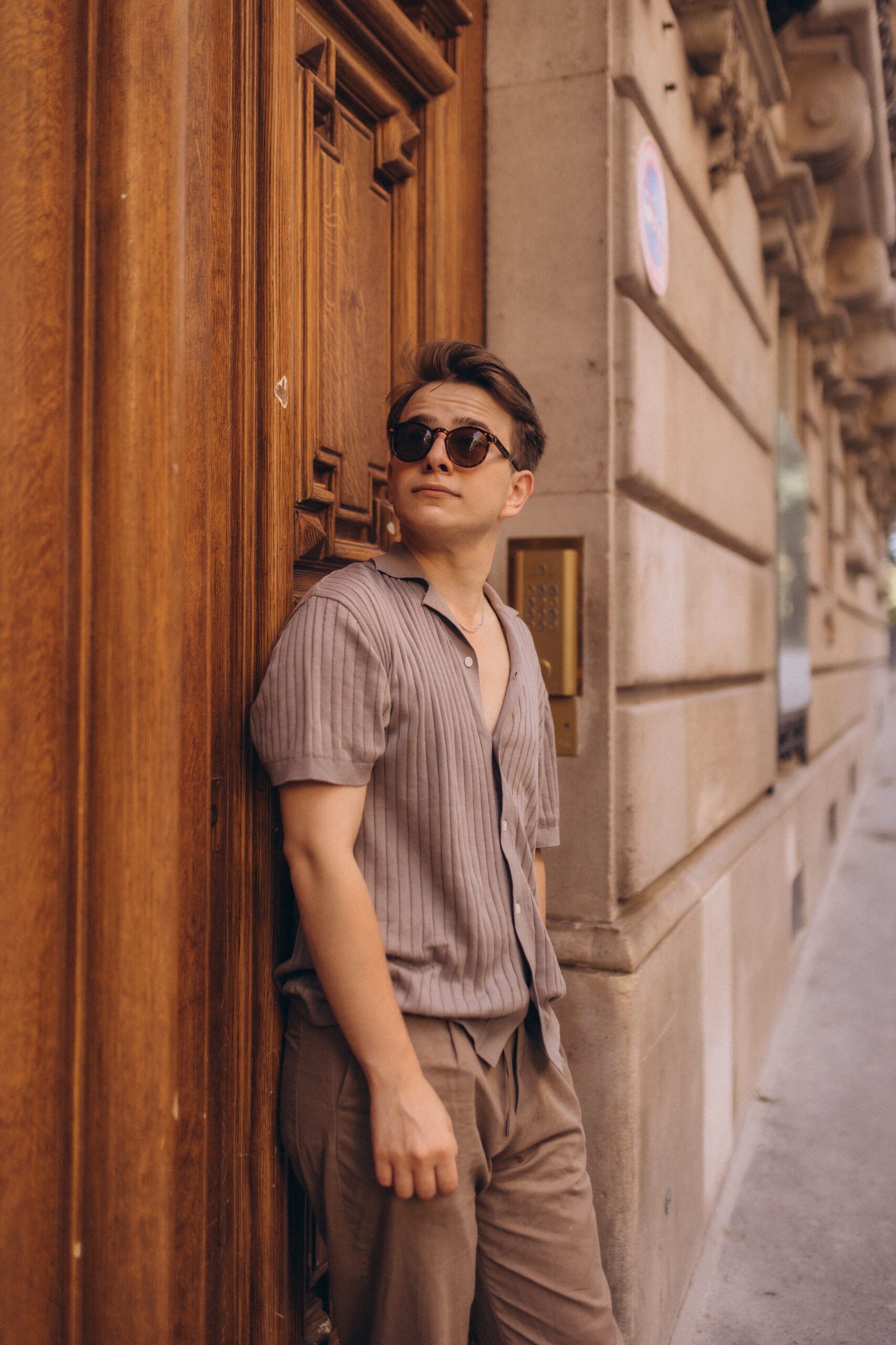
A few minutes after the wider photographs, I used a large wooden doorway for a closer architectural portrait. The warm grain echoes the brown and taupe tones of his outfit, while the vertical panels create a strong frame beside his body. He leans back and looks upward behind dark glasses. Nothing is extravagant, but the combination of texture, posture, and directional light gives the image an editorial quality.
This is why I never treat a Paris street as empty space behind the subject. Pavement, doors, parked vehicles, shadows, and the occasional passerby are active parts of the photograph. I simplify them through position and depth of field, but I do not erase the life that makes the setting believable.
Four Unusual Streets for Paris Street Photography
This series was made on a different route, but it raises a question I often hear: where can a street portrait feel unmistakably Parisian without repeating the most familiar viewpoint? For street photography in France, the answer is often found in small streets with one strong visual identity. These are four unusual options I consider when their atmosphere suits the person and the story.
Rue des Degrés
Rue des Degrés is extraordinary because it is barely a conventional street. Located in the 2nd arrondissement, it measures only 5.75 meters and consists almost entirely of a staircase with 14 steps. There are no sweeping vistas to rely on, so the geometry has to carry the portrait. Its compact scale works beautifully for strong vertical compositions, graphic shadows, and images in which a single figure dominates the frame.
Rue du Chat-qui-Pêche
Its name translates as the Street of the Fishing Cat, which already makes it one of the most memorable addresses in Paris. This narrow passage in the 5th arrondissement is no more than about 1.8 meters wide and is considered one of the city’s narrowest streets. For a portrait, the close walls create intimacy, depth, and an almost secretive mood. It is better suited to restrained frames than to large groups or elaborate movement.
Rue des Thermopyles
Rue des Thermopyles in the 14th arrondissement offers a completely different visual language. Paving stones, small houses, wisteria, climbing plants, and community gardens create the feeling of a country lane hidden inside Paris. Greenery can frame the face naturally, while the low buildings keep the photographs intimate. It is especially appealing when I want a softer portrait story that values texture and calm over recognizable monuments.
The Flower-Named Streets of Cité Florale
Cité Florale in the 13th arrondissement is a tiny residential enclave whose streets carry flower names, including Rue des Glycines, Rue des Orchidées, Rue des Iris, Rue des Liserons, and Rue des Volubilis. Pastel houses, vines, balconies, and flower-filled entrances give every turn a gentle change of color. It is a lovely choice for light clothing, romantic portraits, and a quieter interpretation of Paris street photography.
These places are residential environments, not outdoor studios. I plan carefully, keep equipment compact, avoid blocking entrances, and respect the people who live there. The unusual character of a street is worth photographing only when the session leaves it as peaceful as it was before my camera arrived.
The Unplanned Moment That Completes the Story
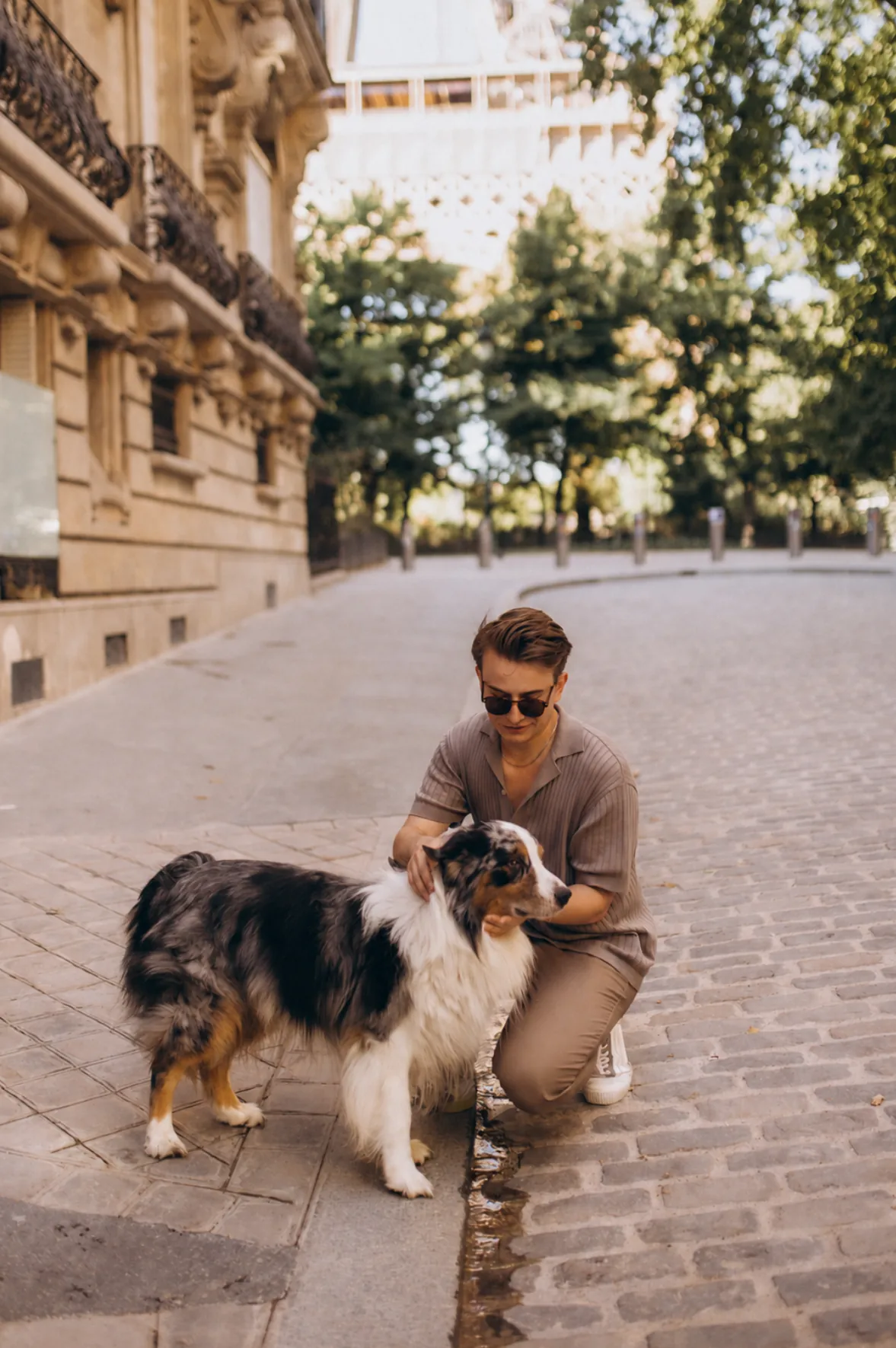
My favorite surprise in this series arrived near the end of the walk. A beautiful dog entered the scene, and the polished street-style mood changed instantly. He crouched beside the dog, smiled down, and reached toward its soft coat. The iron structure remained visible through the trees, but it was no longer the emotional center of the frame. The connection between a person and an animal became the photograph.
Moments like this reveal what Paris street photography can add to a guided portrait session. I can choose the route and light, but I cannot schedule every meaningful second. I keep my Canon EOS R ready while walking because the transition between two planned locations may contain the image that feels most alive. A passing bicycle, a gust of wind, or a friendly dog can bring out an expression that no formal instruction could reproduce.
Spontaneity does not replace craft. I still watch the background, the direction of movement, and the space around the subject. My work is to recognize an unscripted moment quickly and give it a clear visual form without interrupting the emotion that made it special.
What to Wear for Street Photography in France
Clothing becomes part of the urban composition, especially in a solo portrait series. Here, the tonal combination of a ribbed taupe shirt, brown trousers, white sneakers, dark sunglasses, and minimal jewelry works beautifully with cream facades, gray pavement, wooden doors, and golden light. The outfit looks modern and intentional, but it does not compete with the city.
- Choose a controlled palette. Two or three related colors help the gallery remain cohesive across different streets.
- Add visible texture. Knitwear, linen, suede, or structured cotton can create depth without loud patterns.
- Wear shoes made for movement. Stylish footwear should still allow you to walk, stand, and sit comfortably.
- Bring one simple accessory. Sunglasses, a watch, or subtle jewelry can create natural actions for your hands.
There is no need to dress like a fictional Parisian. Street photography in France can be elegant, casual, bold, minimal, or playful. I help refine the wardrobe so it supports the location while preserving the person’s own style.
Soft Light, Quiet Corners, and Natural Direction
Light determines how a street portrait feels. Strong overhead sun can create distracting shadows and flatten warm stone. I prefer softer light, often earlier or later in the day, when facades reflect warmth and the transition between sun and shade becomes gentler. Quieter hours also give me more freedom to create wide compositions without asking the city to stop moving.
Cars appear, pedestrians cross the frame, and delivery vehicles pause in clean backgrounds. I do not treat that unpredictability as a failure. For Paris street photography, evidence of real life can make an image richer. I simply decide which details strengthen the story and which distract from it.
My direction stays simple. I may ask someone to walk toward the light, adjust an accessory, lean against a doorway, or sit for a closer portrait. If you have never been professionally photographed, you do not need to arrive knowing what to do. You can read more about how I guide personal sessions on my Paris portrait photographer page.
Planning Your Own Paris Street Photography Session
A Paris street photography session can be created for a solo traveler, artist, entrepreneur, graduate, content creator, or anyone who wants an atmospheric portrait. It can feel polished without becoming formal and recognizable without repeating one postcard composition. The street provides variety, while the person gives the series its identity.
For travelers exploring street photography in France, Paris offers an extraordinary meeting of architecture and everyday movement. Yet the most valuable photographs are not always the ones with the largest landmark. They may be the close portrait beside an old door, the relaxed smile at the curb, or the unplanned encounter that changes the mood of the entire gallery.
If you are drawn to Paris street photography and want the city to feel present without losing yourself inside it, I would love to create a personal street portrait story with you. Bring an outfit that feels like your own, a little curiosity, and no experience in front of the camera. I will guide the light, movement, and composition while leaving room for Paris to offer its beautiful surprises.